
Understanding Biomarkers
What are Biomarkers?
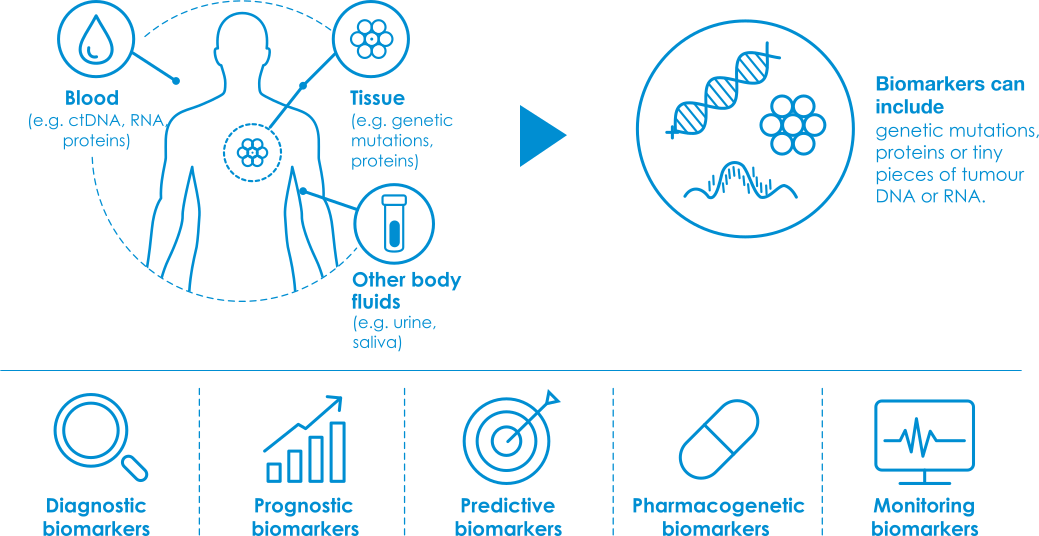
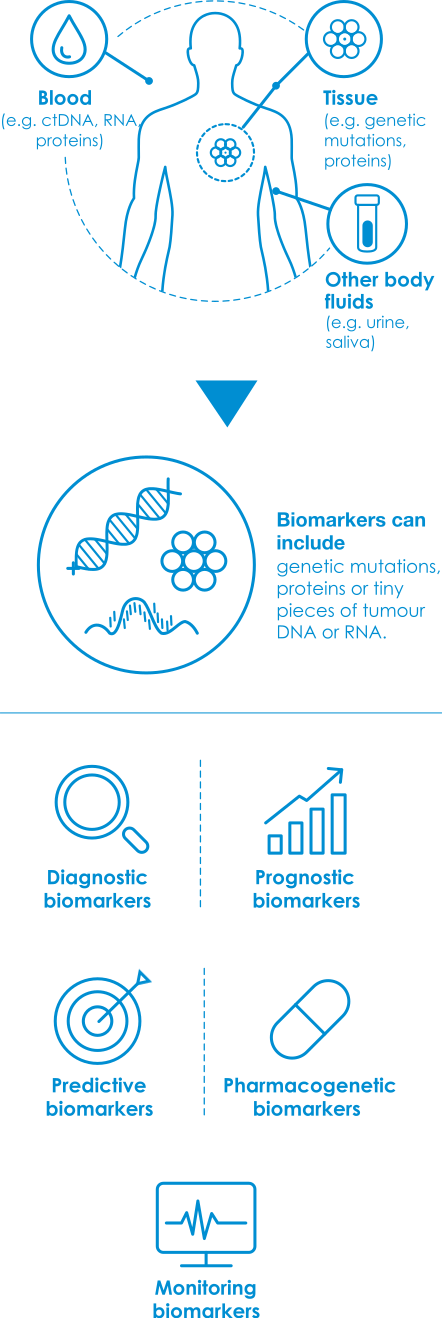
Biomarkers are measurable indicators found in blood, tissue or other body fluids that give valuable information about health and disease1. Doctors look for a few different things when testing for biomarkers. These can include changes in genes (known as genetic mutations), proteins made by the tumour, or tiny pieces of tumour DNA or RNA circulating in the bloodstream. Essentially, biomarkers act as tools to measure and understand exactly what is happening inside the body1,2.
Types of biomarkers in cancer care
Biomarkers are classified based on the type of information they provide1:
- Diagnostic biomarkers: used to help detect and confirm cancer and distinguish between different tumour types.
- Prognostic biomarkers: provide information about the likely course of the disease, independently of treatment (for instance, whether a cancer is likely to grow rapidly or spread).
- Predictive biomarkers: indicate whether a patient is likely to respond to a specific treatment. These are critical in selecting targeted therapies or immunotherapies.
- Pharmacogenetic biomarkers: help determine how the patient body processes a drug and guide dosing decisions, reducing the risk of severe side effects.
- Blood tumour markers for monitoring cancer: used to track disease progression or detect recurrence (cancer coming back) after treatment. These are often measured repeatedly over time.
Importantly, some biomarkers may serve multiple roles simultaneously, depending on the clinical context.
Why do Biomarkers matter?
Each tumour is unique. Even cancers that start in the same organ and appear similar under the microscope can have different molecular characteristics, which influence how they behave and respond to treatment3.
Biomarkers help identify these specific characteristics, acting like a “fingerprint” of the tumour. By understanding these biomarkers, healthcare teams can gain important information about the disease and select the most appropriate treatment for each patient1,2.
Biomarker testing allows doctors to:
- Identify individuals at higher risk of cancer
- Help detect cancer early in specific clinical situations
- Determine the specific characteristics of a tumour, identifying the tumour subtype and knowing if the tumour has a germline (inherited) or somatic (acquired) mutation
- Predict tumour aggressiveness
- Select the most effective treatments for each patient
- Minimize unnecessary treatments and reduce side effects
- Monitor disease progression or cancer returning after treatment (recurrence) over time
This approach in modern oncology is the basis of precision medicine, helping ensure that treatment decisions are based on the individual characteristics of each patient and their cancer4.
Importantly, biomarker testing can also open access to innovative therapies and clinical trials, as many clinical trials are designed for patients whose tumours carry specific changes in the cancer cells, making biomarker identification a key step in accessing new treatment options5.
Despite its growing importance in oncology, biomarker testing is not yet available to all patients across Europe. Access varies between countries, and many patients are not fully informed about what their biomarker results mean. Improving access to testing and helping patients understand their results are important steps towards more personalised cancer care6.
1. Ahmad, A., Imran, M. & Ahsan, H. Biomarkers as Biomedical Bioindicators: Approaches and Techniques for the Detection, Analysis, and Validation of Novel Biomarkers of Diseases. Pharmaceutics 15, 1630 (2023).
2. Zafar, S. et al. Emerging biomarkers for early cancer detection and diagnosis: challenges, innovations, and clinical perspectives. Eur. J. Med. Res. 30, 760 (2025).
3. De Palma, M. & Hanahan, D. The biology of personalized cancer medicine: Facing individual complexities underlying hallmark capabilities. Mol. Oncol. 6, 111–127 (2012). 4. Rituraj et al. Precision oncology: transforming cancer care through personalized medicine. Medical Oncology 42, 246 (2025).
5. Zhou, Y. et al. Tumor biomarkers for diagnosis, prognosis and targeted therapy. Signal Transduct. Target. Ther. 9, 132 (2024).
6. Salam, R. A. et al. Factors Associated With Implementation of Biomarker Testing and Strategies to Improve Its Clinical Uptake in Cancer Care: Systematic Review Using Theoretical Domains Framework. JCO Precis. Oncol. https://doi.org/10.1200/PO-25-00063 (2025) doi:10.1200/PO-25-00063.