
How does biomarker testing work?
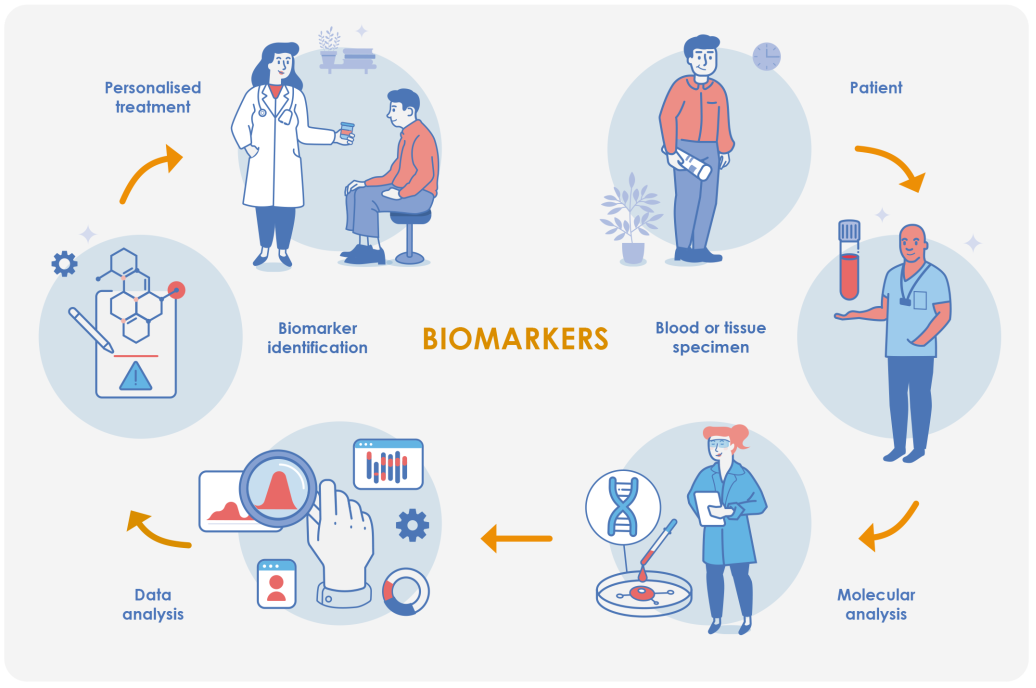
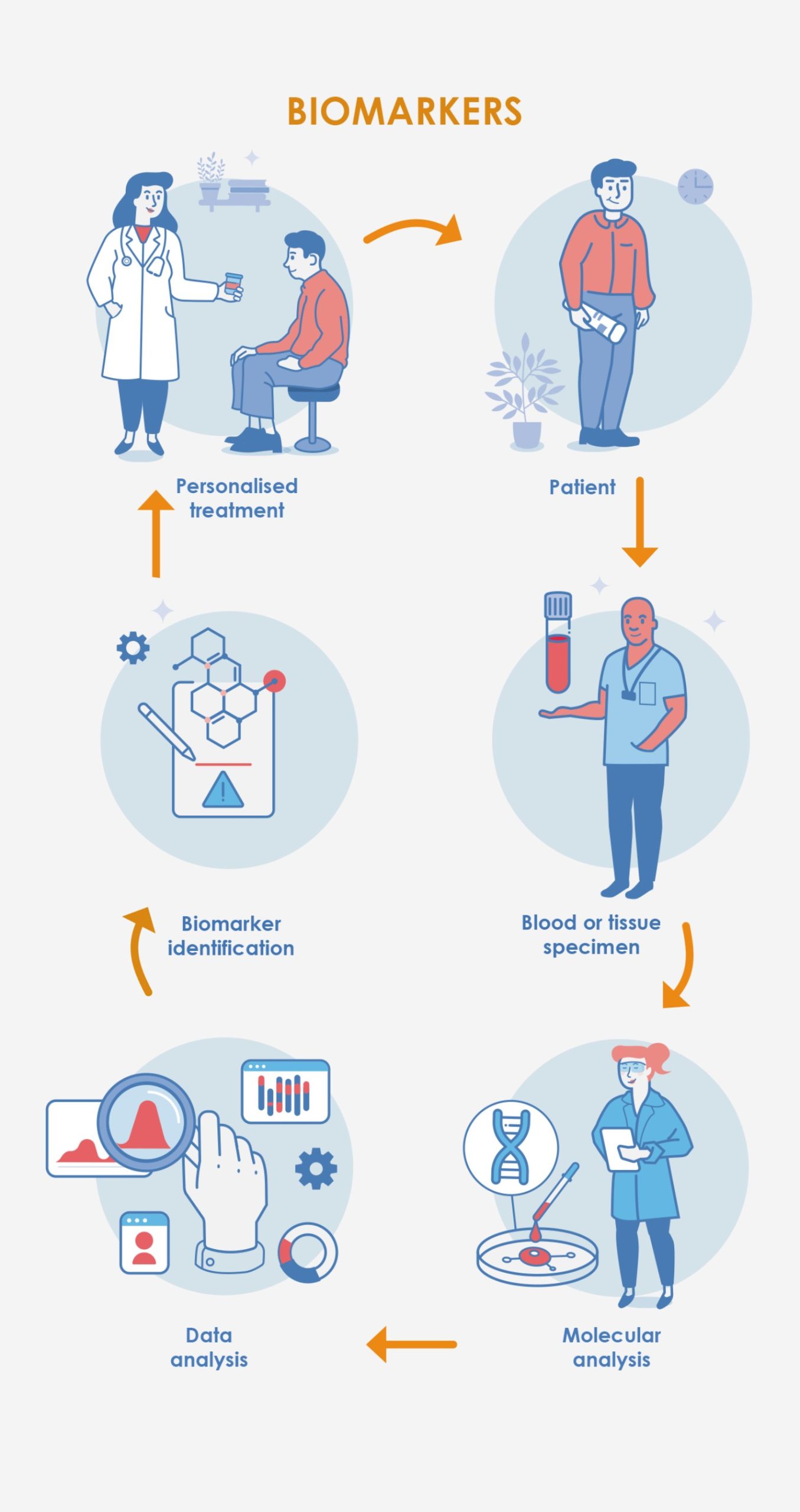
Understanding how biomarker testing fits into cancer care can help patients feel more informed and empowered. Biomarker testing usually involves the following steps:
Step 1. A sample is collected
After a cancer diagnosis, once the type and stage of the cancer have been confirmed, a sample from the tumour itself or, in some cases, a blood sample is collected for biomarker testing. This sample can be obtained in different ways:
- Tissue biopsy (most common method): a small sample of the tumour is collected during an endoscopy, surgery, or needle biopsy and sent to a specialised laboratory to directly analyse the cancer and identify specific molecular changes1.
- Liquid biopsy: uses blood sample or other body fluids to look for signs of cancer, such as circulating tumour DNA (ctDNA) or circulating tumour cells (CTCs). This less invasive approach allows doctors to monitor tumour changes in real time, helping doctors monitor treatment response or detect early signs of recurrence2,3,4. It may also better capture tumour heterogeneity, meaning differences between cancer cells in different parts of the body. However, despite these advantages, liquid biopsy is not yet routinely used in all clinical settings and is often considered complementary to tissue biopsy rather than a replacement5.
Step 2. The sample is analysed
Once a sample is collected, different laboratory techniques are used depending on the biomarker being analysed. These include:
- Immunohistochemistry (IHC): detects proteins directly on tumour samples6,7
- In situ hybridisation (ISH): identifies gene amplification or rearrangements6
- Polymerase Chain Reaction (PCR): detects specific mutations6,7
- Next-Generation Sequencing (NGS): analyses multiple genes simultaneously, providing a comprehensive molecular profile of the tumour3,6,8.
Different cancers have different biomarkers, and not every patient will need the same tests. Sometimes the laboratory looks for one specific biomarker. In other situations, several biomarkers are analysed at the same time using advanced techniques such NGS, which provides a broader picture of the tumour characteristics3,6,8.
In the context of precision oncology, you may also have cancer biomarker testing referred to as9:
- Tumour genetic testing or tumour marker testing
- Genomic testing, genome sequencing, or genomic profiling
- Next generation sequencing
- Molecular testing or molecular profiling
- Somatic testing
- Tumour subtyping
Step 3. Interpretation and reporting of results
Once the laboratory has completed the analysis, the results are interpreted by trained pathologists and molecular specialists and compiled into a final report that typically includes:
- Molecular alterations detected (for example, KRAS mutation, HER2 positive, MSI-high status)
- What those biomarkers may mean
- Whether they may influence treatment options
These results are then discussed within a multidisciplinary care team to guide treatment decisions, including the eligibility for a targeted therapy, immunotherapy, or clinical trial.
The presence of a biomarker alone does not necessarily mean that cancer is present or that the cancer has returned. That is why this is one piece of information used in combination with other diagnostic tests9.
Step 4. Monitoring during treatment
During treatment, the healthcare team can monitor how the cancer is responding using blood tests, imaging scans and, in some cases, additional biomarker testing. This helps determine whether treatment is working or whether changes to the treatment plan may be needed.
Step 5. Follow-up after treatment
After treatment, regular follow-up appointments help monitor your recovery and check for signs if the cancer has returned. Depending on the type of cancer and the individual situation, follow-up may include blood tests, scans and, in some cases, repeat biomarker testing.
When should biomarker testing happen?
Biomarker testing is usually performed as early as possible after a cancer diagnosis, before treatment starts. This gives the healthcare team important information to help choose the most appropriate treatment. However, biomarker testing is not only performed at diagnosis. It may be recommended9:
- Before treatment, to help guide treatment decisions. If you begin receiving a treatment before knowing your tumour type, this may exclude you from future treatment options, including some clinical trials
- During treatment, if doctors need more information about how the cancer is responding
- If the cancer grows or comes back, as new changes can develop over time that may open up different treatment options or clinical trials
1. Zafar, S. et al. Emerging biomarkers for early cancer detection and diagnosis: challenges, innovations, and clinical perspectives. Eur. J. Med. Res. 30, 760 (2025).
2. Anees, M. et al. Liquid biopsy biomarkers for early detection of gastrointestinal cancers: Current landscape and emerging technologies. Clin. Transl. Med. 16, (2026).
3. Rituraj et al. Precision oncology: transforming cancer care through personalized medicine. Medical Oncology 42, 246 (2025).
4. Molla, G. & Bitew, M. The Future of Cancer Diagnosis and Treatment: Unlocking the Power of Biomarkers and Personalized Molecular-Targeted Therapies. Journal of Molecular Pathology 6, 20 (2025).
5. Bardelli, A. & Pantel, K. Liquid Biopsies, What We Do Not Know (Yet). Cancer Cell 31, 172–179 (2017).
6. Molnar, A. et al. Tumors of the Digestive System: Comprehensive Review of Ancillary Testing and Biomarkers in the Era of Precision Medicine. Current Oncology 30, 2388–2404 (2023).
7. Zhou, Y. et al. Tumor biomarkers for diagnosis, prognosis and targeted therapy. Signal Transduct. Target. Ther. 9, 132 (2024).
8. Rulten, S. L., Grose, R. P., Gatz, S. A., Jones, J. L. & Cameron, A. J. M. The Future of Precision Oncology. Int. J. Mol. Sci. 24, 12613 (2023).
9. Biomarker Testing for Cancer Treatment. National Cancer Institute. https://www.cancer.gov/about-cancer/treatment/types/biomarker-testing-cancer-treatment.