
Pancreatic Cancer Guide

Blood tumour markers used to monitor pancreatic cancer

CA 19-9
The most commonly used biomarker in pancreatic cancer is carbohydrate antigen 19-9 (CA 19-9). This substance is released into the blood by cancer cells and can help doctors estimate how active the disease is. Higher levels are often associated with more advanced disease, while decreasing levels during treatment may suggest that therapy is working1,2,3. After surgery, rising CA 19-9 levels may sometimes indicate that the cancer has returned before symptoms appear1,2. However, CA 19-9 is not suitable for screening or early detection because it lacks sufficient sensitivity and specificity2,4. Not all patients produce this marker, and elevated levels may also occur in several non-cancerous conditions3,5. For this reason, CA 19-9 results must always be interpreted alongside imaging and clinical findings rather than used on its own2,6.
Biomarkers that may help guide treatment
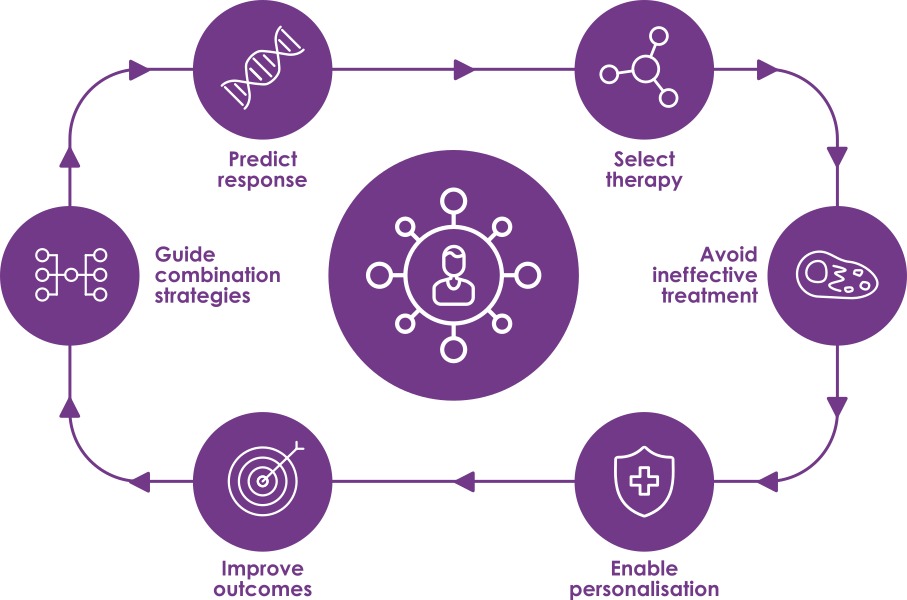
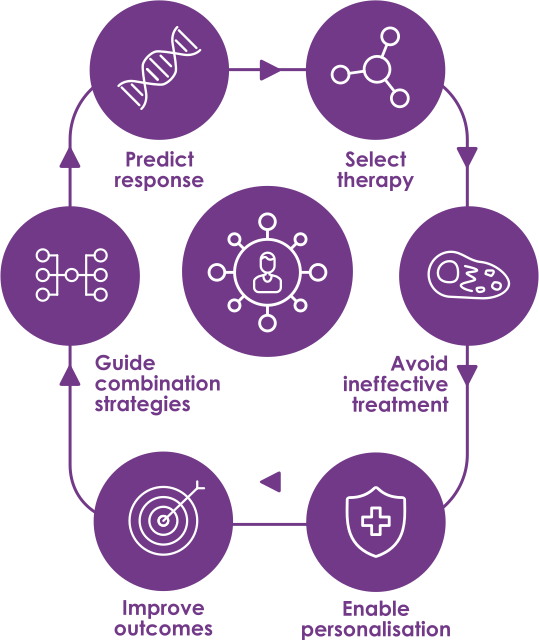
Mutations in the Kirsten rat sarcoma viral oncogene homolog (KRAS) gene are present in more than 90% of pancreatic cancers and represent one of the main drivers of tumour growth. These alterations are generally associated with more aggressive disease and have important implications for tumour behaviour and emerging treatment strategies7.
Historically, KRAS was considered very difficult to target therapeutically. However, major advances in drug development are beginning to change this landscape. Newer targeted therapies directed against specific KRAS mutations, particularly KRAS G12C inhibitors such as sotorasib and adagrasib, have shown promising results in some tumour types and are being investigated in pancreatic cancer. Although KRAS G12C mutations are uncommon in pancreatic cancer, these therapies represent an important step toward more personalised treatment approaches1,3.
In addition, a new generation of therapies designed to target a broader range of KRAS and RAS alterations is currently under development. These include pan-RAS or RAS(ON) inhibitors, such as daraxonrasib, which aim to switch off abnormal RAS signalling across multiple mutation subtypes. Daraxonrasib has recently been approved for patients with metastatic pancreatic cancer who have previously received treatment. This marks an important step forward in expanding treatment options for people living with pancreatic cancer and represents a promising new direction in pancreatic cancer therapy.
Inherited or acquired mutations in the BRCA1, BRCA2, and PALB2 genes are important biomarkers in pancreatic cancer. BRCA1 and BRCA2 mutations are identified in approximately 5-7% of patients, while PALB2 alterations are found in 3-4% of familial pancreatic cancer cases3. Other genes involved in DNA repair proteins, such as ATM, CHEK2, and FANCA, may also play a role in some patients8. These mutations are particularly important because they can increase the risk of developing several types of cancer, including breast, ovarian, prostate, and pancreatic cancer. Identifying them can therefore help guide not only treatment decisions but also genetic counselling and cancer risk assessment for patients and their families8.
These genes play essential roles in repairing damaged DNA. When they are altered, cancer cells become less able to repair DNA damage and therefore more sensitive to certain treatments. Patients carrying these alterations may benefit from platinum-based chemotherapy as well as poly (ADP-ribose) polymerase (PARP) inhibitors such as olaparib1,3.
The mismatch repair (MMR) system, involving genes such as MLH1, MSH2, MSH6, and PMS2, acts as the body’s DNA “spell-checker”, correcting mistakes that happen when cells divide. When this system does not work properly, these mistakes build up, resulting in mismatch repair deficiency (dMMR) and microsatellite instability-high (MSI-H) status. These changes can make cancer cells easier for the immune system to recognise them. Although MSI-H/dMMR pancreatic cancers are rare (approximately 1-2%), they are clinically important to identify because patients may benefit from immunotherapy, especially immune checkpoint inhibitors such as pembrolizumab3,9.
Neurotrophic tyrosine receptor kinase (NTRK) gene fusions are extremely rare in pancreatic cancer (approximately 0.3%)9. Nevertheless, they are highly actionable alterations because tumours carrying these fusions may respond well to TRK inhibitors such as larotrectinib or entrectinib9,10.
Emerging and less established biomarkers
Beyond the currently established biomarkers, pancreatic cancer frequently harbours additional molecular alterations that are helping improve our understanding of tumour biology and may expand future therapeutic opportunities.
Other less common but potentially actionable alterations include BRAF mutations, particularly BRAF V600E, which are identified in only 3% of patients with advanced pancreatic cancer9. Rare gene fusions involving neuregulin 1 (NRG1) are also being investigated, with emerging targeted therapies such as zenocutuzumab showing promising early results11.
Human epidermal growth factor receptor 2 (HER2) amplification or overexpression has also been identified in a small subset of pancreatic cancers. In HER2-positive cases, anti-HER2 therapies such as trastuzumab or trastuzumab deruxtecan may offer potential benefit, particularly within clinical trials3.
Similarly, epidermal growth factor receptor (EGFR) signalling may contribute to pancreatic tumour growth. Erlotinib combined with gemcitabine has shown modest benefit in some studies, although EGFR-targeted therapies currently play only a limited role in routine pancreatic cancer management12.
Overall, advances in molecular profiling are gradually expanding the number of biomarker-driven treatment options available for pancreatic cancer, particularly for small patient subgroups. However, many emerging biomarkers currently remain most relevant within comprehensive genomic profiling programmes, precision oncology initiatives, and clinical trials rather than routine standard-of-care treatment decisions.
1. Moretti, M., Farina, A., Angeloni, A. & Anastasi, E. Emerging horizons on molecular and circulating biomarkers in pancreatic adenocarcinoma. Front. Oncol. 14, (2024).
2. Vitale, F. et al. The Past, Present, and Future of Biomarkers for the Early Diagnosis of Pancreatic Cancer. Biomedicines 12, 2840 (2024).
3. Sun, J., Awad, M. A., Hwang, J. & Villano, A. M. Molecular Biomarkers for the Diagnosis and Prognostication of Pancreatic Ductal Adenocarcinoma. J. Pers. Med. 15, 236 (2025).
4. Sturgeon, C. Practice Guidelines for Tumor Marker Use in the Clinic. Clin. Chem. 48, 1151–1159 (2002).
5. Anees, M. et al. Liquid biopsy biomarkers for early detection of gastrointestinal cancers: Current landscape and emerging technologies. Clin. Transl. Med. 16, (2026).
6. Conroy, T. et al. Pancreatic cancer: ESMO Clinical Practice Guideline for diagnosis, treatment and follow-up. Annals of Oncology 34, 987–1002 (2023).
7. Fivaz, M., Bornand, A., Corro, C., Koessler, T. & Genoud, V. Actionable mutations in pancreatic cancer: where targeted therapies are making a difference. BMJ Open Gastroenterol. 12, e001925 (2025).
8. Casolino, R. et al. Homologous Recombination Deficiency in Pancreatic Cancer: A Systematic Review and Prevalence Meta-Analysis. Journal of Clinical Oncology 39, 2617–2631 (2021).
9. Brozos-Vázquez, E. et al. Pancreatic cancer biomarkers: A pathway to advance in personalized treatment selection. Cancer Treat. Rev. 125, 102719 (2024).
10. Saoudi Gonzalez, N., Patelli, G. & Crisafulli, G. Clinical Actionability of Genes in Gastrointestinal Tumors. Genes (Basel). 16, 1130 (2025).
11. Schram, A. M. et al. Efficacy of Zenocutuzumab in NRG1 Fusion–Positive Cancer. New England Journal of Medicine 392, 566–576 (2025).
12. Chiramel, J. et al. Targeting the Epidermal Growth Factor Receptor in Addition to Chemotherapy in Patients with Advanced Pancreatic Cancer: A Systematic Review and Meta-Analysis. Int. J. Mol. Sci. 18, 909 (2017).