
From the Other Side of the Laboratory Door
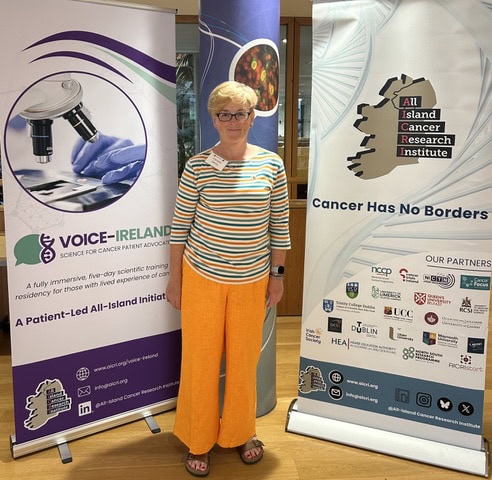
On my first day in the laboratory, I extracted DNA from a banana. Soon afterwards, I was using gel electrophoresis, observing cancer cells and learning how researchers grow and study cells. As I stood at the laboratory bench, I kept thinking about the extraordinary journey that had brought me there.
I know cancer from the other side of the laboratory door. I was diagnosed with pancreatic cancer and have experienced chemotherapy, radiotherapy and major surgery. I know what it is like to wait for treatment to work, to wait for scan results and to live with the effects of treatment long after it has ended. VOICE-Ireland gave me an opportunity to see cancer research from another perspective.
I was one of thirteen patient advocates from across the island of Ireland selected for the first VOICE-Ireland Science for Cancer Patient Advocates programme. This immersive residency, held over five days, was driven by the All-Island Cancer Research Institute (AICRI) and led by patient advocates working with cancer researchers. It adapts the VOICE model created by Independent Cancer Patients’ Voice at Barts Cancer Institute, Queen Mary University of London, and places lived experience at the centre of cancer research.
Before the programme, I usually entered research conversations as the person asked to explain the patient experience. VOICE-Ireland gave me the scientific grounding to follow the questions being asked, understand the methods used to investigate them and recognise the evidence needed before a discovery can begin to benefit patients.
Across the week, we explored cancer biology and genetics, oncogenes and tumour suppressor genes, cell growth and cell death, cell culture, confocal microscopy, laboratory methods, and mathematical and computational modelling. Practical sessions put those ideas into our hands. We worked with gel electrophoresis, observed cancer cells and learnt how researchers investigate cancer at a cellular level.
Working through the science made the research process less remote. I began to understand why a particular experiment is undertaken, how evidence is built and why the journey from a laboratory finding to a treatment or test can be so complex. Behind every result are carefully framed questions, repeated experiments, limitations and uncertainty. Patients usually encounter only the final stages of that journey, often when we are waiting for an answer that could change our lives.
That understanding matters because patient advocates are increasingly invited to contribute to research, health technology assessment, policy and regulatory discussions. These conversations can be highly scientific and technical. Inviting a patient into the room is only the beginning. Meaningful involvement requires knowledge, confidence, time and support.
VOICE-Ireland helped create a shared language. Researchers could hear directly what matters to patients, while we gained a clearer understanding of the processes, possibilities and limitations that shape their work. That exchange has changed how I think about my own advocacy.
I am particularly interested in pancreatic cancer research, where the distance between scientific progress and daily patient experience can feel enormous. Research needs to ask whether a treatment works and what living with that treatment means. What happens to digestion? How does fatigue affect daily life? What are the effects over the longer term? Can a person work, walk, travel and take part in ordinary life? These outcomes belong within successful cancer research.
VOICE-Ireland strengthened my belief that patients should be involved much earlier. With a grounding in research, advocates can ask better questions, challenge respectfully and identify outcomes that conventional measures may overlook. Researchers, in turn, need to recognise lived experience as a form of knowledge. Partnership does not require patients to become scientists or scientists to become patients. It requires enough mutual understanding to work together as equals.
With knowledge came confidence. I now see my role as a patient advocate more clearly. It extends beyond telling my story. I can bring my experience into the places where research is designed, questions are chosen and decisions are made.
Nothing about us without us must mean more than patient presence. It means giving people the knowledge, opportunity and support to participate meaningfully. VOICE-Ireland showed me what that looks like.
I am grateful to AICRI, the patient advocates who led the programme and every partner who made the first VOICE-Ireland programme possible. Thirteen of us arrived with different experiences of cancer, connected by something none of us would ever have chosen. We left with a stronger grasp of the science, greater confidence in what we can contribute and a community that makes our collective voice stronger.
The programme comprised four and a half days at University College Dublin and half a day at Trinity St James’s Cancer Institute in Dublin.
Author:
