
Europe’s Colorectal Cancer Screening Gap: New Index Reveals Who Is Being Left Behind
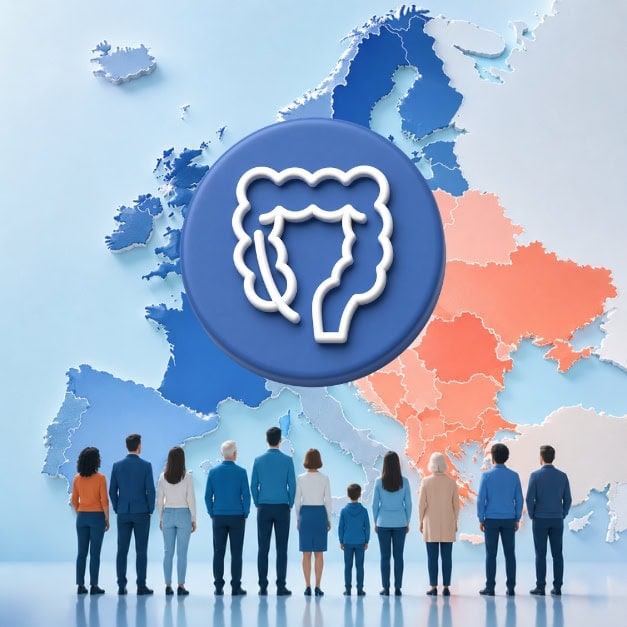
Despite decades of evidence showing that colorectal cancer screening saves lives, access and participation continue to vary widely across Europe. The newly launched 2026 European Cancer Screening Policy Index highlights just how large these gaps remain. For Digestive Cancers Europe (DiCE), the Index is particularly relevant because it shows that, while Europe has made progress in colorectal cancer screening, access and participation still vary widely across countries.
Colorectal cancer remains one of Europe’s most urgent cancer challenges. In 2022, there were an estimated 361,986 new cases of colorectal cancer in Europe and 161,182 deaths[1]. Many of these deaths could be avoided through earlier detection and better implementation of screening programmes.
The difference for patients is dramatic. The five-year survival rate for colorectal cancer patients diagnosed at stage I is around 90%, compared with only about 10% for people diagnosed at stage IV[2]. Screening can detect cancer before symptoms appear and when treatment is more likely to be successful. It can also identify precancerous lesions before they become cancer.
Screening also makes sense financially. In addition to improving outcomes, early detection may reduce healthcare costs associated with treating advanced disease[3]. Investing in screening, therefore, means saving lives, improving quality of life and reducing avoidable pressure on health systems.
The 2026 Index shows why this remains so important. Looking specifically at colorectal cancer screening, participation across Europe varies widely. Some countries report relatively strong participation rates, such as Finland at 74%, the Netherlands at 67%, Sweden at 65%, and Slovenia at 61%. Others remain far behind, including Poland at 8%, Bulgaria at 4%, and Cyprus and Romania at 3%[4]. Although screening programmes differ between countries, the data reveal substantial inequalities in participation across Europe.
These gaps show that a programme on paper is not enough. Screening only works if eligible people are invited, informed, supported and able to complete the pathway, from test to timely follow-up colonoscopy, diagnosis and treatment when needed. This requires organised invitation systems, reminders, quality assurance, enough diagnostic capacity, and communication that people can understand and trust.
Equity must also be at the centre. Opportunistic screening risks reaching mainly those who already have better access to healthcare, higher health literacy or more resources. Organised programmes, when properly implemented, can help reach people who are too often left behind, including those facing social, economic, geographic or language barriers.
This has long been at the heart of DiCE’s advocacy. From our White Paper on colorectal cancer screening to our work on screening inequalities and patient-centred implementation[5], DiCE has consistently called for screening policies that move beyond formal availability and focus on real participation, timely diagnosis and equal access.
DiCE also advances this work through its annual CRC Screening Summit, which brings together experts, policymakers, healthcare professionals, and patient advocates to discuss how screening can be implemented more effectively across Europe. The 6th DiCE CRC Screening Summit continued this focus, with discussions on how to scale up effective, accessible and equitable CRC screening programmes[6].
It is also the message behind European Colorectal Cancer Awareness Month (ECCAM). Led by DiCE since 2008, ECCAM remains a key opportunity every March to raise awareness, share prevention messages, and encourage action [7]. With colorectal cancer rates expected to rise, including among younger Europeans, this work is more important than ever.
The 2026 European Cancer Screening Policy Index is a reminder that Europe already has many of the tools needed to reduce the burden of colorectal cancer. The task now is to turn commitments into participation, earlier diagnosis and better outcomes for every eligible person, regardless of where they live.
[1] European Cancer Inequalities Registry / European Commission Joint Research Centre, Uncovering Inequalities: Colorectal Cancer Screening in Europe, March 2024: https://publications.jrc.ec.europa.eu/repository/handle/JRC137531.
[2] Cancer Research UK, Bowel cancer survival statistics, “Survival by stage”: https://www.cancerresearchuk.org/about-cancer/bowel-cancer/survival
[3] Digestive Cancers Europe, Colorectal Screening in Europe: Saving Lives & Saving Money, White Paper, 2019.
[4] European Cancer Organisation, European Cancer Screening Policy Index, May 2026, country ranking and colorectal cancer screening table.
[5] Digestive Cancers Europe, Interventions to Reduce Cancer Screening Inequities, 1 February 2023: https://digestivecancers.eu/interventions-to-reduce-cancer-screening-inequities/.
[6] Digestive Cancers Europe, 6th DiCE CRC Screening Summit, 4 December 2025: https://digestivecancers.eu/events/6th-dice-crc-screening-summit/.
[7] Digestive Cancers Europe, European Colorectal Cancer Awareness Month (ECCAM),About the campaign: https://eccam.digestivecancers.eu/about-the-campaign/.
Author:
