
Europe’s Beating Cancer Plan: The Real Failure Is Implementation
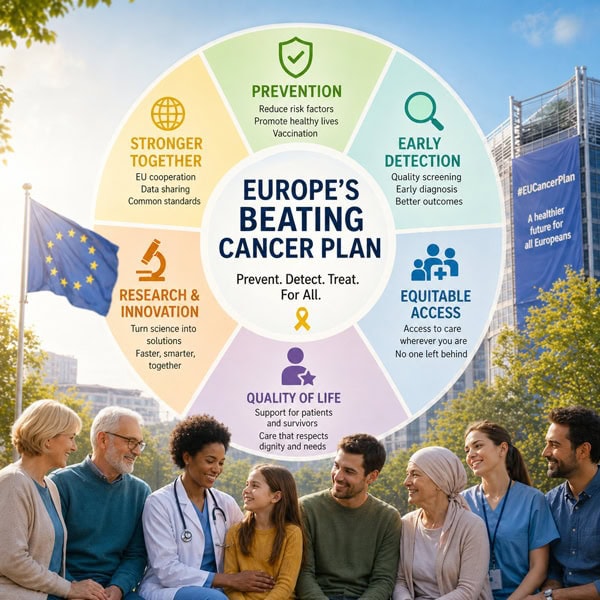
On 14 April 2026, MEP Vlad Voiculescu (Renew, Romania) presented his report on the implementation of Europe’s Beating Cancer Plan in the European Parliament’s Committee on Public Health (SANT). In it, he frames one of Europe’s key challenges as the gap between strong scientific research and the ability to translate that innovation into real-world solutions that reach patients, including through faster regulatory processes and better deployment of new technologies.
But reading it from a patient’s perspective begs the question: are we focusing on the right problem?
Imagine two people, both 60 years old, living in different parts of Europe.
One receives a direct invitation for colorectal cancer screening, followed by reminders. The programme is organised, population-based and supported by a central registry. They complete the test. A lesion is detected early. Treatment is timely, less invasive and highly effective.
The other lives in a Member State where screening exists on paper, but is not systematically implemented. There are no regular invitations, no reminders, and limited follow-up. Participation is low. They are not screened. Months later, they are diagnosed with colorectal cancer at an advanced stage.
Simply on the basis of where you were born, your chances of being diagnosed early – and ultimately surviving – can change dramatically.
This is not a hypothetical scenario. While many EU countries have established organised screening programmes, others still rely on opportunistic approaches or struggle to ensure consistent participation. Even where programmes exist, participation remains highly inconsistent (ranging from approximately 9% to 74%), reflecting major differences in their implementation in practice.
Early detection saves lives. Yet, despite the clear benefits of screening, a significant implementation gap persists across Europe. This is particularly worrying in colorectal cancer, as it is the second most common cancer in the EU.
At the same time, the incidence of colorectal cancer among younger adults has nearly doubled since the 1990s in many high-income countries. These patients fall outside current screening programmes by design and are more likely to be diagnosed at later stages, when treatment is less effective, and survival is lower.
This is not a failure of screening programmes per se, but it does raise a broader question: are our current approaches to early detection keeping pace with changing epidemiology? Strengthening symptom awareness, improving diagnostic pathways in primary care and exploring more targeted, risk-based approaches will be essential.
Even when cancer is detected, access to care is not equal. Not all patients can reach Comprehensive Cancer Centres. Referral pathways to specialised expertise are often unclear, and participation in clinical trials remains concentrated in a limited number of centres. Cross-border care for cancer patients, while possible, is still difficult to navigate.
For many patients, these barriers directly affect outcomes. Innovation alone cannot solve this. Access must be part of the solution.
Prevention remains the most effective and cost-efficient approach to reducing the cancer burden. Up to 40% of cancers are preventable, with measures such as vaccination against HPV and hepatitis B playing a key role for certain cancer types, including anal and liver cancer, respectively. Yet vaccination coverage remains uneven, while essential policies on tobacco, alcohol and unhealthy diets continue to face delays.
The ambition of Europe’s cancer strategy should be clear: to prevent as much cancer as possible, and for what cannot be prevented, to detect it as early as possible when treatment is most effective, and survival outcomes are highest.
Innovation matters. But it cannot compensate for late diagnosis or unequal access to care.
Ultimately, the success of Europe’s cancer strategy will not be measured in EMA approval timelines or regulatory speed, but in something far more important – how many lives we save.
Author:
