
Promising Precision Approaches for Colorectal Cancer
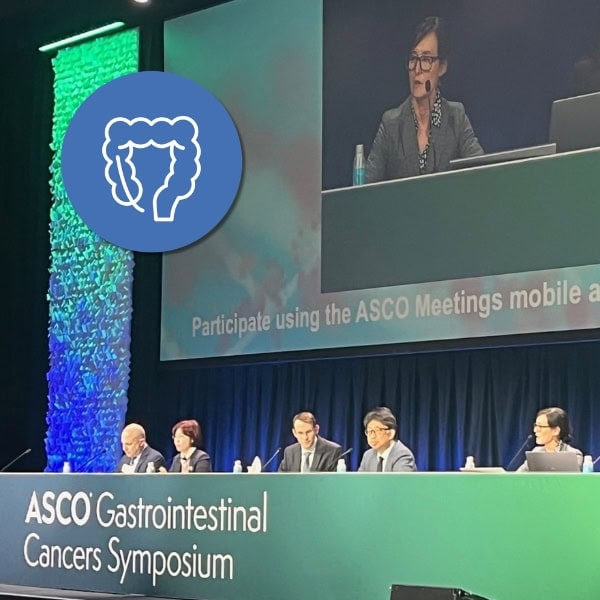
Recent data presented at the 2026 American Society of Clinical Oncology Gastrointestinal Cancers (ASCO GI) symposium underscored both significant progress and ongoing challenges in the treatment of colorectal cancer (CRC) and anal cancer. Many of the studies focused on precision medicine, meaning treatments are increasingly chosen based on specific features of each patient’s cancer rather than a one-size-fits-all approach.
BREAKWATER Trial – Targeted treatment for a specific type of colorectal cancer (BRAF-mutant metastatic CRC)
One of the most practice-changing results presented at ASCO GI came from the BREAKWATER trial, which focused on patients with metastatic CRC carrying a specific genetic mutation called BRAF V600E. This type of cancer is known to be more aggressive and harder to treat. The study compared standard chemotherapy versus a combination of chemotherapy (FOLFIRI) plus targeted drugs (Encorafenib and Cetuximab) designed to block the BRAF pathway [1–3]. Patients who received the targeted treatment alongside chemotherapy were more likely to see their tumours shrink and live longer than those treated with chemotherapy alone. Side effects were in line with what is already known for these drugs.
Key takeaway: These results support earlier use of targeted treatments for patients with BRAF-mutant metastatic CRC and underscore the importance of genetic testing at diagnosis to guide treatment decisions.
COMMIT Trial – Combining treatments in immunotherapy-sensitive colorectal cancer (dMMR/MSI-H metastatic CRC)
The COMMIT trial studied patients with a type of CRC that usually responds better to immunotherapy, known as deficient mismatch repair / high microsatellite instability (dMMR/MSI-H) [4]. Researchers compared immunotherapy (Atezolizumab) alone with a more intensive approach that added chemotherapy (mFOLFOX6) and a drug that affects tumour blood supply (anti-angiogenic therapy called Bevacizumab). The triplet combination treatment helped dMMR/MSI-H metastatic CRC patients live longer without their cancer worsening and increased the number of patients whose tumours responded to treatment. However, this approach also led to more side effects.
Key takeaway: While immunotherapy remains highly effective for many dMMR/MSI-H metastatic CRC patients, some may benefit from stronger treatment combinations. The challenge is to identify who needs more intensive treatment and how to balance benefit with side effects and quality of life.
PLATO ACT5 Trial – Tailoring radiotherapy in high-risk anal cancer
For patients with high-risk and locally advanced anal cancer, the PLATO ACT5 trial explored whether higher doses of radiotherapy could improve outcomes [5, 6]. The study compared standard-dose chemoradiotherapy with two higher-dose treatment approaches, using modern intensity-modulated radiotherapy techniques designed to limit side effects. The results showed that increasing the radiotherapy dose did not improve short-term outcomes or response rates compared with standard treatment, and side effects were similar across all groups.
Key takeaway: Standard-dose chemoradiotherapy remains the recommended treatment for patients with high-risk and locally advanced anal cancer. Longer follow-up will help clarify whether higher doses offer any long-term benefit.
Overall message: 2026 ASCO GI shows that precision-based approaches are increasingly shaping care for colorectal and anal cancers. Treatments are becoming more tailored to tumour biology, but important challenges remain, especially in balancing effectiveness and side effects and in choosing the right treatment intensity for each patient.
References:
[1] Elena E, Takayuki Y, Lin S, et al. Encorafenib, Cetuximab, and mFOLFOX6 in BRAF-Mutated Colorectal Cancer. New England Journal of Medicine 2025; 392: 2425–2437.
[2] Kopetz S, Yoshino T, Van Cutsem E, et al. Encorafenib, cetuximab and chemotherapy in BRAF-mutant colorectal cancer: a randomized phase 3 trial. Nat Med 2025; 31: 901–908.
[3] Kopetz S, Wasan HS, Yoshino T, et al. BREAKWATER: Primary analysis of first-line (1L) encorafenib + cetuximab (EC) + FOLFIRI in BRAF V600E-mutant metastatic colorectal cancer (mCRC). Journal of Clinical Oncology 2026; 44: 13–13.
[4] Rocha Lima CMSP, Yothers G, George TJ, et al. Colorectal Cancer Metastatic dMMR Immunotherapy (COMMIT) study: A randomized phase III study of atezolizumab (atezo) monotherapy versus mFOLFOX6/bevacizumab/atezo (FFX/bev) in the first-line treatment of patients (pts) with deficient DNA mismatch repair (dMMR) or microsatellite instability-high (MSI-H) metastatic colorectal cancer (mCRC)— NRG-GI004/SWOG-S1610. Journal of Clinical Oncology 2026; 44: 14.
[5] Hawkins MA, Gilbert A, Adams R, et al. Early outcomes of the PLATO ACT5 randomised trial: Personalizing anal cancer radiotherapy dose. Journal of Clinical Oncology 2026; 44: 1.
[6] Frood R, Gilbert A, Gilbert D, et al. Personalising anal cancer radiotherapy dose (PLATO): protocol for a multicentre integrated platform trial. BMJ Open 2025; 15: e109655.
Author:
